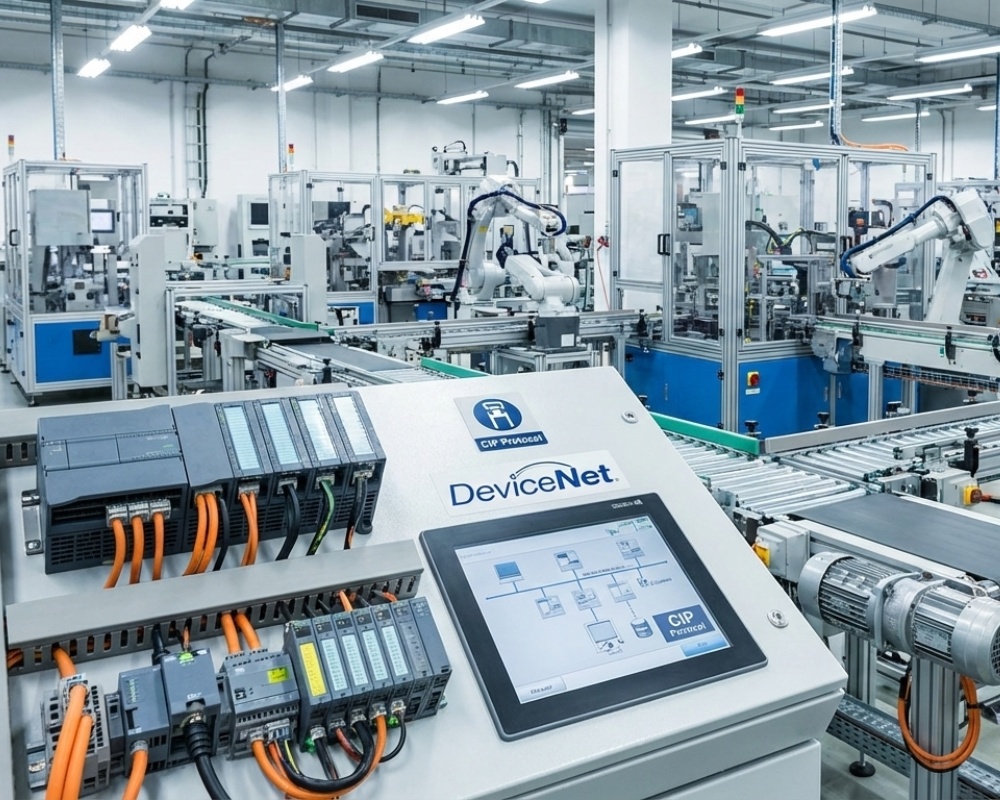
In the complex ecosystem of industrial automation, DeviceNet stands as a robust application-layer protocol that brings intelligence to the device level. Unlike lower-level protocols that simply move bytes, DeviceNet built on the Common Industrial Protocol (CIP) conveys inherent meaning. Whether it is an explicit message requesting a specific service code or an I/O message driving a motor, DeviceNet ensures every bit of data has a purpose.
RAPIDSEA's DeviceNet stack bridges the gap between raw CAN (Controller Area Network) signals and sophisticated industrial applications, providing a standardized, object-oriented framework for sensors, actuators, and controllers.
Eliminate recurring costs. Pay once and deploy across your entire product line without per-unit fees.
Our code is audited for safety and reliability, adhering to MISRA-C standards to minimize bugs and ensure predictable performance in mission-critical environments.
Benefit from ultimate portability. Our stack is written in pure ANSI C, making it compatible with virtually any MCU/CPU and RTOS.
Fully compliant with the latest ODVA specifications, ensuring seamless interoperability with third-party scanners, adapters, and configuration tools.
At the heart of our DeviceNet stack is the Common Industrial Protocol (CIP). We represent every device as a collection of objects, making system management intuitive and scalable.

Manages Vendor ID, Serial Numbers, and Device State.
The central hub that directs explicit messages to their target objects.
Handles physical parameters like MAC ID and Baud Rate (125k, 250k, 500k).
Manage the lifecycle of I/O and explicit messaging paths.
Our implementation optimizes the Message Router, ensuring that even low-resource 8-bit or 16-bit microcontrollers can process complex CIP packages with minimal latency.
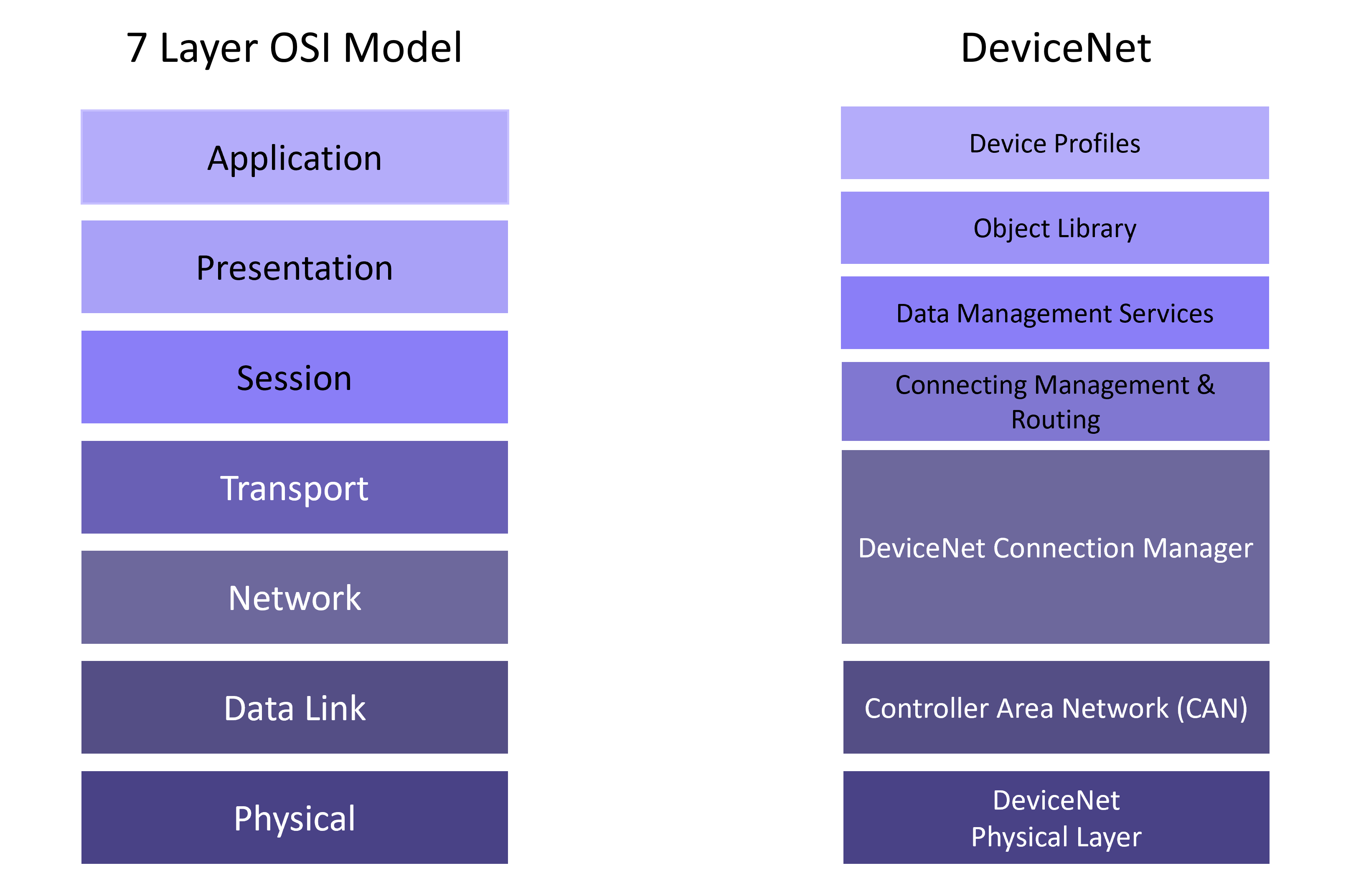
At its core, RAPIDSEA's DeviceNet stack leverages CIP for higher-layer functions, mapping seamlessly to the OSI model. The physical layer uses CAN over twisted-pair cables for power and data transmission, while the data link handles framing and error detection. CIP manages transport, network, session, presentation, and application layers, allowing interoperability with protocols like EtherNet/IP. This integration ensures devices like sensors and actuators communicate via objects and attributes, supporting master/slave and peer-to-peer models. For instance, explicit messaging configures devices, while I/O connections handle real-time data. RAPIDSEA adds modern capabilities like IoT gateway support, enabling hybrid networks for cloud analytics - a feature not always standard but crucial for future-proofing.

RAPIDSEA's DeviceNet stack powers a variety of industrial scenarios:
Contact sales to learn moreCoordinates sensors and actuators for precise part placement, reducing downtime.
Monitors temperature controllers in real-time, ensuring compliance with safety regs.
Integrates drives and valves for sterile environments, supporting change-of-state alerts.
Enables peer messaging for synchronized operations, boosting throughput.
Handles cyclic data from remote sensors in power grids, with added IoT for predictive maintenance.
A DeviceNet protocol stack is a software implementation that enables devices to communicate using the ODVA DeviceNet standard over CAN, supporting CIP objects, explicit messaging, and real-time I/O data exchange.